Tuesday, 15 November 2011

Film review - Moulin Rouge

Film review
Moulin Rouge - (Baz Luhrmann 2001)


This touching film explodes onto the screen with vibrant, bright, dazzling energy that unleashes a contentment for life - then amazingly pulls at the heart strings in a flurry of realisation back into reality. The euphoria you feel at the start of the film, which is almost just too theatrical to be on the cinema, is certainly shaken to wake you up and realise how precious every little second of life truely is. The moral to this story for me is, take what you can, do not waste life and make the most of life in the moment.

The film is based on Ewan McGregors character, "Christian", embarking on a journey to Paris, where he encounters the bohemian society of the Moulin Rouge. It is here where he and his new friends, of whom are neighbours of his new apartment go to let loose and enjoy life. Christians friends arrange a naughty swindle to get him and the lead attraction of the Moulin Rouge "Satine" to get together after the show. Of course, this happens and Christian isn't to repel this offer, as he believes she genuinely wants to meet up with him after the show. Satine on the other hand believes that Christian is a duke of whom she was suppost to be meeting before the fix up, who the head of the Mouline Rouge "Harold Zidler" is hoping will take interest in his finest attraction. Harold wishes to make a deal, of which could make the Moulin Rouge a lot of money, to do this he must pull a few strings. In true fashion to the day where women were less respected, Harold uses Satine as bait to blind Harold into agreeing to sign the paper.

The twist is, Christian falls deeply in love with Satine. From the moment he met her he was transfixed, as he has a funny obsession with love, yet believes he has never felt it before. As a writer, it is his one ambition to know what it feels like so he can pursue his writing to its fullest. The problem with Satine is that she is so used to pretending to feel love for Gentlemen, so used to prostituting herself, that she fails to initially accept her true feelings. This is probably because she is confused by emotion, something of which she is used to holding back, ignoring and getting on with each day at a time.

I love how it provides that artificial grasp at the feeling of love by building an emotion. It uses the qualities such as build ups, tension, held back passion and the longing of two people with the same passion, even if something gets in their way they fight back to fall back into each others arms.


Over the course of the film we find out that Satine is terminally ill and to pursue his plan, the greedy Harold makes her carry on performing, not allowing her to find out about her condition. The jealous Duke makes sure nothing stands in the way of his prized Satine, so when he becomes suspicious about Christian he puts up a plot to have him killed. It is here where we find out that Satrine really loves Christian, as she sadly is forced to tell him she doesnt love him after finding out his fate, and unfortunately, her own. In an attempt to save Christian from a broken heart and an early grave, she knows this is the only way. We know that Satine is talented in the art of acting, usually to give a man what he desires, so she puts this skill to use for an opposite effect for the first time.

I noticed how the film starts out fast and jerky, with impatient cuts and energetic displays of camera work. Over time, in contrast to Satrines quickly declining condition, the film begins to slow down. Thus, this is when the powerful death scene takes place. Christian returns to the Moulin Rouge for one last time to declare how he feels about Satine, which turns into an attempted murder on Christian. I felt a sense of sadness at Christians bravery, however it was not for nothing. He made the love of his life feel for the first time and be able to acknowledge it, in that moment of death where she was slipping away in his arms that whisper spoke a thousand lifetimes. As a result, Christian continued her memory with the fulfillment of what he always wanted - to understand and feel the power of love. So he wrote, with a heavy heart and in his lonely state, about Satine and her impact on his life. This somehow compares to most broken relationships, many come to think of love as happiness, whereas most humans will know the happiness is usually within the indulgence of another, yet man is never satisfied in the end.

Overall a brilliantly crafted film which I have a lot of time for. Powerful and entertaining, shocking and emotive.

Chris

Film reviews - Scream

Film review
Scream (Wes Craven – 1996)

Scream was Directed by Wes Craven and released in 1996.

Scream is one of them movies that open’s straight into the action, preparing the audience for a thrilling ride of viewing intensity and a warning of bloodied gore early on. The opening sequence to the film is almost the most memorable part of the film and we make a connection with the Character Casey, played by Drew Barrymore, almost instantaneously. She is in effect the MacGuffin of the movie, as she is what is referred to throughout yet taken out of the film physically very early on.

The movie is about the murder of a School Girl, who is one of a number of people targeted by a Hooded, Ghost faced costumed killer on the loose in a small American Town. The first Girl to be killed, Casey, sets off a local pandemonium mainly within the Towns High School. The Teenagers are all both suspects and to be protected, incase this killer goes loose again.

In typical slasher movie style, there are tension build-ups, chilling music and almost predictable outcomes. The classic sign given in Scream that a character was going to be killed was by receiving a phone call from the killer infamously called “Ghost face”. If anything this film is an attempt at recreating the slasher effect of the early films of this style while avoiding an initial cliché. It pays homage to a lot of old characteristics of film making origin of its kind, yet somehow still upholds a modern, more lighthearted feel.

The film, although always being drove onwards by the initial panic and mystery of Casey’s murder, follows a young Student named Sidney (Neve Campbell) who comes to find she is the new prey of the killer. In her efforts to evade the killer, other students and people become victims of the killer and this helps to drive to story forward into its somewhat relentlessly unforgiving conundrum.

The original suspect of the movie is suggested early in the film itself once Sidney becomes the apparent target, so therefore we can initially suggest that this isn’t our killer. This is due to a year before the film being set we come to learn that Sidney’s Mother was brutally raped and murdered, which puts the characters eyes upon Sidney’s missing Father. As the film progresses we start to see links to other key characters and events, such as Sidney’s Prince Charming Boyfriend Billy (Skeet Ulrich). It is almost obvious when Billy climbs in through the window immediately after an attack, with a phone falling out of his sleeve. The Character Billy has something dark about him that we initially see right through, with a swift change in the flow of the plot the film diverts our suspicions away from Billy and we feel more comfortable with him afterwards. This is not to last however, as Billy has merely had a close shave and we come to find that he is actually involved in the murders taking place.

The indulgent fear that strikes into the tension of the film almost becomes like a game, the movie portrays it almost as if the murders are fun and with an excitement to find out who exactly is causing the problems. This is why I think this film is very clever, it can appear funny, referencing itself through comparisons of other horror films and as we see in later sequels even referencing its own success as a horror movie. Even through a rusty sense of humour this film can drive panic into the audience, it can make people jump, it can confuse you, it always has something new every time you see it and strangely enough it can separate you to either will on the hero or the villain in the movie.

I like how the film can really drag you into a typical “American Dream” style suburbia, where even through horrific events such as murder there are still elements about the surroundings that make you feel a comfort that its too perfect to be true. This perfection is almost balanced back to normality by the murders themself which to me somehow is what makes the film less scary than it could be and if anything puts a subconscious form of relief into the audience. If something is too pretty and too good to be true then how can it exsist in an imperfect world? It can’t and it shouldn’t, that’s what drives people who want order by chaos.

The way in which the cameras seem to focus on the scenes derives in two main ways; first we have the typical longer shots, with longer cuts and fewer pans. This keeps the feel of the moment to be more relaxed, chilled out and without too much care. We can take in the beauty of a setting or comfortably get a relaxed shot of a character while they announce their lines. Then there is the other form of camera work used, which is faster cuts, cameras panning around a character to make them seem surrounded, close up’s of a characters panic driven face and even the odd cheesy zoom in during a chase.

The music used within this film is typical for a jumpy horror movie, there are subtle build-ups in tone and then explosions of edgy chaotic string based instrumentals.

To go along with the “perfect” culture driven along in this movie, we come to find the film reference itself in a meta narrative way of depicting the “rules” of a horror movie.


Randy: “There are certain rules that one must abide by in order to successfully survive a horror movie! For instance, Number One: You can never have sex. (crowd moans and cheers) Sex equals death, OK? Number Two: You can never drink or do drugs. (crowd moans and cheers) No, it’s the sin factor, it’s a sin, it’s an extension of Number One! And Number Three: Never, ever, ever, under any circumstances say ‘I’ll be right back’, ‘cause you won’t be back.”


It is also interesting to note how there are some characters seemingly obsessed with horror movies throughout, how they seem to know how they work to pull of a decent killing. This helps to further invoke a suspicion into who the killer could be, either by an obsession with how to go about murders or by the person who seems to know less about it. It leaves the audience in a perplexed state of mind, which is later carried out as a true example of how the remaining murders are carried out. Interestingly enough when the character Randy explains the rules to a horror movie the groans and mumbles of the other characters in the room almost makes it seem like the characters are aware of being within a horror movie.

Unfortunately this film had such an effect of comparing itself to other movies of its sort and how to go about being a successful horror film, that it strangely became the grounds for a real murder using the exact voice changer and costume as seen in the film in real life. This was called the Scream Murders and happened in the January of 1998. It is almost as if it is basing itself on a meta dictatorship and consuming the rules of “Scream” and “Scream 2” as if it is a guide and our reality is merely a film that we choose a genre for. It is a scary reality but on open terms it is a correct notion, especially considering we are filmed nearly every day of our life’s in public, or what we see with our own eyes is no different to that of a cinema screen, we direct the cuts as we direct our life’s.

Overall I believe this film to be highly interesting and Wes Craven really did his homework to make this twisted Teen Horror flick come to life.

Brilliant film 8/10

Chris

Tuesday, 18 October 2011

Life drawing 2 - Charcoal

Finally my internet at home is starting to work again after a painful transistion to SKY Broadband (dont do it people!) and finally I can get on my blog a bit more again. Heres a quick catch up of a life drawing class a few weeks ago where we used charcoal to create the images of the model. The paper was smeared in black charcoal so that we could erase parts to allow for light and dark areas of the picture, then using the usual methods of measuring and shapes I continued to draw how I draw!

Do excuse the watermark on my images, I cant seem to shake them!


Chris

Wednesday, 12 October 2011

Character design: Victorian clothing

The clothing style of the Victorian era is most distinct and is set apart vastly by social hierarchy. The overall observation is that it is quite varied, however it was a time when colour schemes seemed most bland and pastel based. In many respects the larger side of the community who were poorer distinctively wore dirtier, less extravagant garments where brighter, rainbow like colours would have been expensive and for the upper class citizen.

I have come across a website which is perfect for referencing the imagery of fashion within the Victorian era, it shows a lot about styles over a specific time period and for different classes of people.

The Mid Victorian Silhouette 1860-1880


Factors Affecting the Fashion Silhouette after 1860


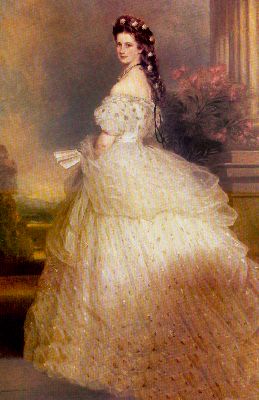
We arrive at 1860 with four significant facts that were to seriously affect fashion of the future. Firstly the sewing machine had been invented, secondly clothes would in future become couture design led, thirdly synthetic dyes would make available intense colours. Fashion history painting showing full crinoline of 1865.Fourthly in 1860 the crinoline domed skirt silhouette had a flattened front and began to show a dramatic leaning toward the garment back.

Charles Worth thought the crinoline skirt unattractive.  However, he is associated with it, as he did manipulate the style, as a result the shape soon changed to a new trained, softer bustled version, which only the really rich found practical.


Right - Dress designed by Charles F. Worth for Empress Elizabeth of Austria and painted by Winterhalter in 1865.


In 1864 Worth designed an overskirt which could be lifted and buttoned up by tabs. This top skirt gave a lot of scope for added ornamentation and by 1868 it was being drawn and looped right up at the back creating drapery and fullness.


The New Princess Line 1866


In 1866 the new Princess gown also changed the line of fashionable dress. The Princess gown was cut in one piece and consisted of a number of joined panels fitted and gored from shoulder to hem that gave the figure shape through seaming.


The Gabriel Princess gown with a small neat white collar was mainly made in grey silk and followed the fuller skirt lines of the era. This is the dress style often used to depict the constrained buttoned up repressed governess character of Jane Eyre in films. Later Princess styles were slimmer and much more form fitting. Sleeves in day dresses were often of a banana shape.


The Soft Bustle Fashion Silhouette 1867-1875


Painting showing crinolines moving to garment back c1866 - Fashion history.
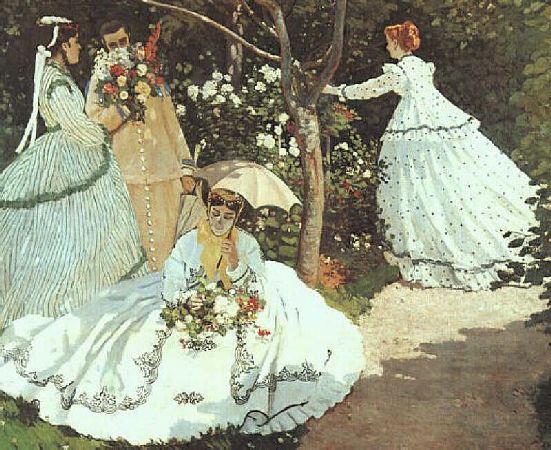
By 1867 with the fullness bunched up to the back of the skirt creating a polonaise style, crinolines and cages suddenly disappeared evolving into tournures or bustles. The bustles supported accentuated drapes on the hips.

Image - Women in the Garden by Claude Monet 1866-7.   The Louvre Paris.
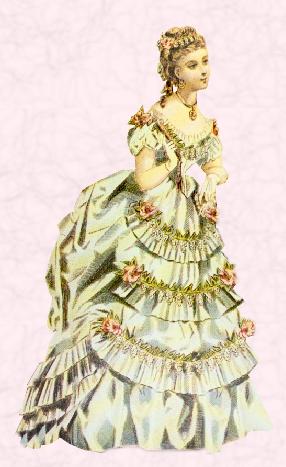
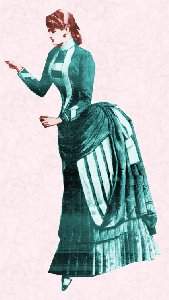
Costume history picture of tiered frill bustle dress fashion.


After 1868 Worth's overskirt really caught on in England and contrasting underskirts and gown linings were all revealed as the over top skirt was divided or turned back. Other top skirts were called aprons and they were also draped making the wearer look like a piece of elaborate upholstery. Rounder waistlines were fashionable and waistlines even began to rise very slightly.


Above on the left a tiered soft bustle ball gown of 1872.   


From 1870, ball gowns always had a train. Soon by 1873 the train was seen in day dress.
By 1875 soft polonaise bustle styles were becoming so extreme that the soft fullness began to drop down the back of the garment and form itself into a tiered, draped and frilled train. Trains were very heavily ornamented with frills, pleats, ruffles, braids and fringing. The sewing machine instead of simplifying sewing, just became a tool to add more ostentation.


The Late Victorian Silhouette 1878 - 1901


By 1878, women of the late Victorian era have a very different look about them compared to earlier Victorian women.

The Princess Line and the Cuirasse Bodice


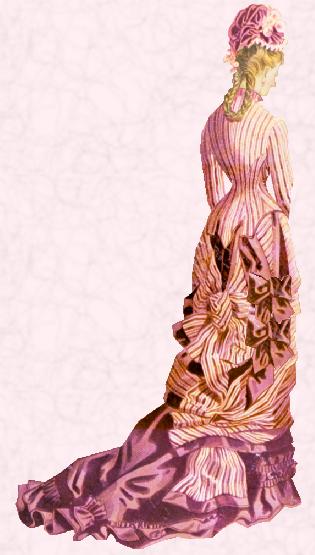
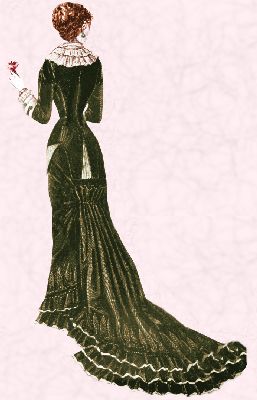
Picture of trained cuiasse bodice dress Fashion history .

The soft polonaise style bustle styles were replaced by Princess sheath garments without a waist seam with bodice and skirt cut in one. The Princess line sheath had a bodice line similar to the very tight fitting cuirasse bodices which had been getting longer and longer.

Right - Slim fitting trained dress with cuirasse bodice 1876.   By 1878 the cuirasse bodice reached the thighs.


By 1878 the cuirasse bodices had reached the thighs. The cuirasse bodice was corset like and dipped even deeper both front and back extending well down the hips creating the look of a body encased in armour.

Picture of slimline trained dress costume history.
By 1880 the two ideas merged and the whole of the dress was in Princess line style with shoulder to hem panels. The silhouette was slim and elongated even more by the train. No bustle was needed for the cuirasse bodice or Princess sheath dress, but a small pad would have helped any trained fabric to fall well. 

Left - The cuirasse bodice of 1880 reached the hem actually becoming the princess panel dress.  It made an exceptionally form fitting draped sheath dress which was elongated even further by the train.


The slimline style needed good dressmaking skills to get a flattering fit. When done well it was attractive, but all too often swathes of fabric were wrapped and arranged across the garment in an effort to disguise poor dressmaking skills. It was not a very practical garment and only really suited to the very slim and those who did not have to work. As a fashion it barely lasted 3 years.


The New Hard Bustle of 1883


Costume history picture of hard bustle dress.

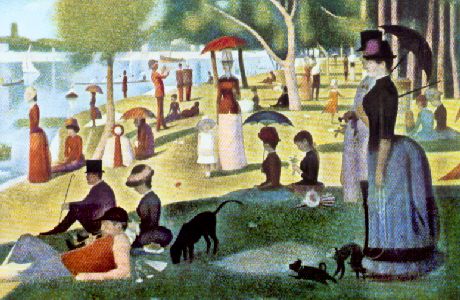
Suddenly out of nowhere in 1883 a new jutting out shelf like style of bustle appeared. It had been shown in Paris in 1880, but as a fashion took off later outside of Paris. It reappeared even larger than ever as a hard shape that gave women a silhouette like the hind legs of a horse as shown in the page heading.

Right - The second hard bustle style 1883.


The new bustle dress had a different look. It had minimal drapery compared to the former and a slimmer more fitted severely tailored princess bodice, with a much flatter front. What drapery there was, was tidily arranged at the front of the dress as a small apron. Soon even that disappeared. For support the spring pivoted metal band Langtry bustle gave the correct foundation for the wider skirts. 
   
Painting of hard bustle dresses - costume history.This later bustle fashion was very moulded to the body and the heavy corsetry gave an armour like rigidity to the silhouette. The pointed bodice began to look quite tailored.
Tailored garments had been introduced in 1874 and their influence on design was subtle, but led eventually to the tailor made suit so fashionable in the 1890s.


Picture of dress after bustle declined. Fashion history
In 1887 the sleeves were still slimmer, plain and close fitting. The sleeves look like quite a different style than on the bustle dress of the 1870s which had sleeves that would not have looked out of place on dresses of 1860.
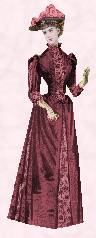
By 1889 silhouette changes now couturier led were changing more rapidly and the sleeve developed a very slight leg of mutton outline which soon needed support.

Right - Dress of 1889 showing signs of elevation at the sleeve head. 


Victorian Fashion History - Power Dressing


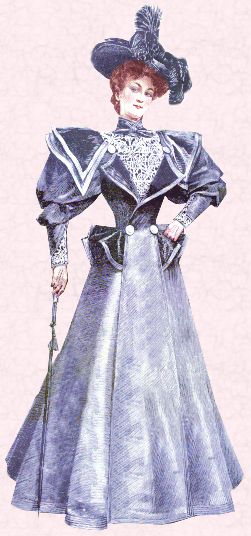
Picture of tailored full sleeved suit. Fashion historyIt's interesting to note how late Victorian women embraced the sharper tailored jacket fashion which gave them a different posture with a more confident air reflecting the ideals of early female emancipation. Other military and more tailor made styles of jacket were also popular. Some dresses also had a more severe air about them.

Left - Tailor made suit of 1895.


There are similarities in the period 1885 with 1985 when women also showed their strength in the corporate workplace with Power Dressing through more masculine tailored, shoulder padded clothes. A similar broad shoulder trend occurred in the Utility Clothing era of the 1940s when women did work usually thought of as men's work.


Bright Aniline Dyed Colours


The gowns of the 1880s were almost always made in two colours of material. Vivid colours such as deep red, peacock blue, bright apple green, royal blue, purple, mandarin, sea green were used alone, in combination, or in tartan fabrics. Some colour combinations were very strange.
At night ladies evening dresses were in softer hues and although they were extravagantly trimmed in contrast fabrics and very décolleté, they followed the general line of fashion.

1890s

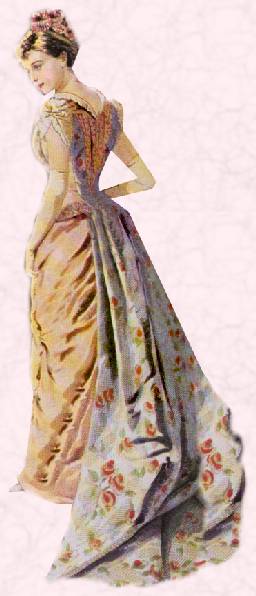
Gradually the skirt widened and flared as the fullness of the bustle began to fall into pleats down the garment back eventually disappearing to nothing.
As before the bustle foundation softened until only a small pad was left by 1893. The armour like hour glass figure soon developed into the S-Bend shape corset which set the Edwardian Corsetry silhouette until 1907-8. 

Left - Evening gown with train 1890. 


Leg of Mutton Sleeves


The leg of mutton sleeves continued to develop and sprouted high above the shoulders, By 1895 the sleeves swelled into enormous puffs similar to those of 1833. As happened in 1830 to balance the huge shoulders the skirt widened and flared, whilst keeping the waist tight and handspan narrow.
Queen Victoria's influence over fashion was long gone. people who were in mourning still followed court guidelines on mourning dress. The real royal influence in fashion was the wife of the Prince of Wales, Princess Alexandra. Together they set the tone for society and fashion in the last decade of the century in the 1890s and into their own reign of the Edwardian era from 1901 to 1910.


Pauline Weston Thomas . (Year Unknown). Mid-Late Victorian Fashion and Costume History. Available: http://www.fashion-era.com/mid-late_victorian_fashion.htm. Last accessed 12/10/2011.

Chris

Group project research: Telekinetic powers

"Most of what we term psychic phenomenon or mystical happenings happen in the "off" phases of consciousness. Consciousness is always in the on/off phasing, blinking off and on, as it were. Off/On phasing phenomenon is photon related manifestation of energy and light.

Telekinesis is essentially the ability to move an object on the physical plane using only psychic power. While some people think that it is an occult practice, this is not strictly so.

A common theory is that TK works by energy fields (magnetic or electric) or by "waves" of psychic energy, which are actually dense enough to push/repel an object."

Unknown. (Year Unknown). Telekinesis. Available: http://www.wingmakers.co.nz/Telekinesis.html. Last accessed 12/10/2011.


The Human Brain has been wrongly claimed in the past to only use 10% of its potential capability. While this is a laughable statement to many of the Scientific world, it is also true that we don't use its full potential at once. This is an excuse to claim an explanation into the unknown world of the paranormal acts that connect to the human mind.

The different types of phsycic powers that use the power of the mind to manipulate their surroundings involve the following:

• Telepathy – his ability to read people’s mind.
• Bending, breaking and softening metal and other solids such as spoons and keys, and more rarely plastic and glass.
• Fixing watches and clocks that had not been working for years.
• Moving compasses with his psychic powers – the power of thought.
• Erasing tapes from the computers.
• Dowsing – locating precious metals by the power of the mind.

Unknown. (Year Unknown). Some famous phsycics. Available: http://www.moonwhisper.com/famous-psychics/958-some-famous-psychics. Last accessed 12/10/2011.

Group project: Dark, telekinetic girl

I have started drawing up sketches of what a teenage school girl with dark abilities might look like. I have used some references to assist my drawings, to get further ideas for what works for this sort of characters visual appearance and what could create the uncanny effect of a corrupt innocence.


Until we gather together a full complete story the job of designing properly is hard. Fortunately a full Synopsis is due to be posted up the evening of this post, gathering together the different group ideas to make one collaborated story merging the different key ideas that work.


I originally had been told by my team mates that the characters shall have exaggerated features and the stylisation will be almost sketchy in appearance. My first impressions was to create the girl to be small and cute, then after a while refraining from the supremely cartoony depiction.


Whilst still not of the world of realism, I had tried to gather together an image of a girl who appeared a bit sterner, colder, harder to approach yet still somewhat a victim to her own inverted emotions. 


After a brief talk with Justin the Character Design tutor, he told me to simplify the Character once again back down into its basic roots and by the power of simple shapes design the exaggerations with obvious intent. This is where the best Character so far actually has emerged, to my opinion.


After observing the Synopsis and finalising the script I will have now got myself into the mindset to work hard at conceptual drawings and the animations theme.

Chris

Tuesday, 11 October 2011

Rough Influence map for girls

Heres a few rough pictures from the net I have taken to help me mold a physical image of the School Girl in my group project. I have a strong image in my head which still seems to blurr and not depict itself properly when I put pen to paper, so therefore I just needed this to gather a better idea for the shapes that would represent the character at its best.


Chris