Showing posts with label Character design. Show all posts

Wednesday, 12 October 2011

Character design: Victorian clothing

The clothing style of the Victorian era is most distinct and is set apart vastly by social hierarchy. The overall observation is that it is quite varied, however it was a time when colour schemes seemed most bland and pastel based. In many respects the larger side of the community who were poorer distinctively wore dirtier, less extravagant garments where brighter, rainbow like colours would have been expensive and for the upper class citizen.

I have come across a website which is perfect for referencing the imagery of fashion within the Victorian era, it shows a lot about styles over a specific time period and for different classes of people.

The Mid Victorian Silhouette 1860-1880


Factors Affecting the Fashion Silhouette after 1860
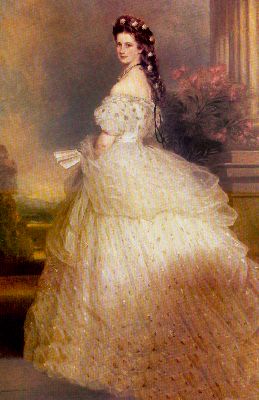


We arrive at 1860 with four significant facts that were to seriously affect fashion of the future. Firstly the sewing machine had been invented, secondly clothes would in future become couture design led, thirdly synthetic dyes would make available intense colours. Fashion history painting showing full crinoline of 1865.Fourthly in 1860 the crinoline domed skirt silhouette had a flattened front and began to show a dramatic leaning toward the garment back.

Charles Worth thought the crinoline skirt unattractive.  However, he is associated with it, as he did manipulate the style, as a result the shape soon changed to a new trained, softer bustled version, which only the really rich found practical.


Right - Dress designed by Charles F. Worth for Empress Elizabeth of Austria and painted by Winterhalter in 1865.


In 1864 Worth designed an overskirt which could be lifted and buttoned up by tabs. This top skirt gave a lot of scope for added ornamentation and by 1868 it was being drawn and looped right up at the back creating drapery and fullness.


The New Princess Line 1866


In 1866 the new Princess gown also changed the line of fashionable dress. The Princess gown was cut in one piece and consisted of a number of joined panels fitted and gored from shoulder to hem that gave the figure shape through seaming.


The Gabriel Princess gown with a small neat white collar was mainly made in grey silk and followed the fuller skirt lines of the era. This is the dress style often used to depict the constrained buttoned up repressed governess character of Jane Eyre in films. Later Princess styles were slimmer and much more form fitting. Sleeves in day dresses were often of a banana shape.


The Soft Bustle Fashion Silhouette 1867-1875
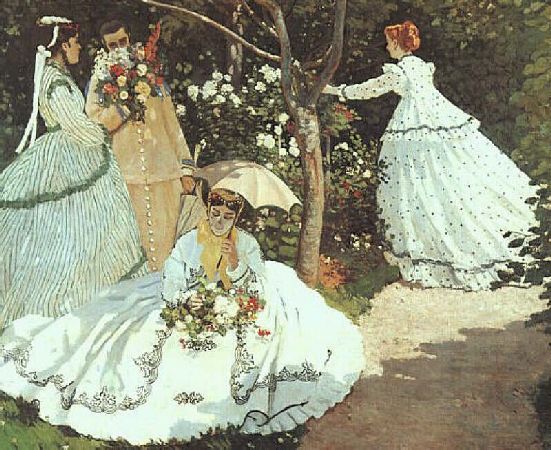

Painting showing crinolines moving to garment back c1866 - Fashion history.
By 1867 with the fullness bunched up to the back of the skirt creating a polonaise style, crinolines and cages suddenly disappeared evolving into tournures or bustles. The bustles supported accentuated drapes on the hips.

Image - Women in the Garden by Claude Monet 1866-7.   The Louvre Paris.
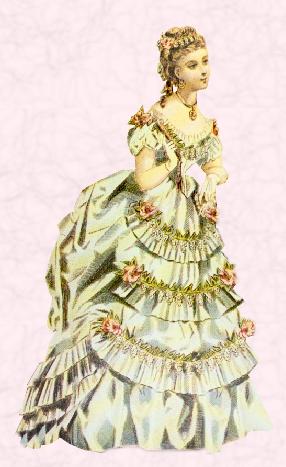
Costume history picture of tiered frill bustle dress fashion.


After 1868 Worth's overskirt really caught on in England and contrasting underskirts and gown linings were all revealed as the over top skirt was divided or turned back. Other top skirts were called aprons and they were also draped making the wearer look like a piece of elaborate upholstery. Rounder waistlines were fashionable and waistlines even began to rise very slightly.


Above on the left a tiered soft bustle ball gown of 1872.   


From 1870, ball gowns always had a train. Soon by 1873 the train was seen in day dress.
By 1875 soft polonaise bustle styles were becoming so extreme that the soft fullness began to drop down the back of the garment and form itself into a tiered, draped and frilled train. Trains were very heavily ornamented with frills, pleats, ruffles, braids and fringing. The sewing machine instead of simplifying sewing, just became a tool to add more ostentation.


The Late Victorian Silhouette 1878 - 1901


By 1878, women of the late Victorian era have a very different look about them compared to earlier Victorian women.

The Princess Line and the Cuirasse Bodice
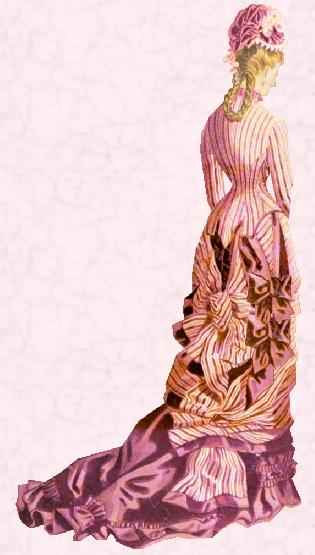

Picture of trained cuiasse bodice dress Fashion history .

The soft polonaise style bustle styles were replaced by Princess sheath garments without a waist seam with bodice and skirt cut in one. The Princess line sheath had a bodice line similar to the very tight fitting cuirasse bodices which had been getting longer and longer.

Right - Slim fitting trained dress with cuirasse bodice 1876.   By 1878 the cuirasse bodice reached the thighs.


By 1878 the cuirasse bodices had reached the thighs. The cuirasse bodice was corset like and dipped even deeper both front and back extending well down the hips creating the look of a body encased in armour.
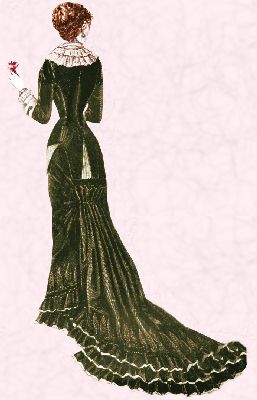
Picture of slimline trained dress costume history.
By 1880 the two ideas merged and the whole of the dress was in Princess line style with shoulder to hem panels. The silhouette was slim and elongated even more by the train. No bustle was needed for the cuirasse bodice or Princess sheath dress, but a small pad would have helped any trained fabric to fall well. 

Left - The cuirasse bodice of 1880 reached the hem actually becoming the princess panel dress.  It made an exceptionally form fitting draped sheath dress which was elongated even further by the train.


The slimline style needed good dressmaking skills to get a flattering fit. When done well it was attractive, but all too often swathes of fabric were wrapped and arranged across the garment in an effort to disguise poor dressmaking skills. It was not a very practical garment and only really suited to the very slim and those who did not have to work. As a fashion it barely lasted 3 years.


The New Hard Bustle of 1883
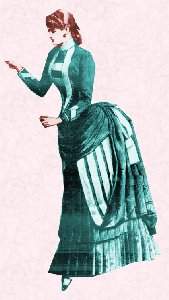


Costume history picture of hard bustle dress.

Suddenly out of nowhere in 1883 a new jutting out shelf like style of bustle appeared. It had been shown in Paris in 1880, but as a fashion took off later outside of Paris. It reappeared even larger than ever as a hard shape that gave women a silhouette like the hind legs of a horse as shown in the page heading.

Right - The second hard bustle style 1883.


The new bustle dress had a different look. It had minimal drapery compared to the former and a slimmer more fitted severely tailored princess bodice, with a much flatter front. What drapery there was, was tidily arranged at the front of the dress as a small apron. Soon even that disappeared. For support the spring pivoted metal band Langtry bustle gave the correct foundation for the wider skirts. 
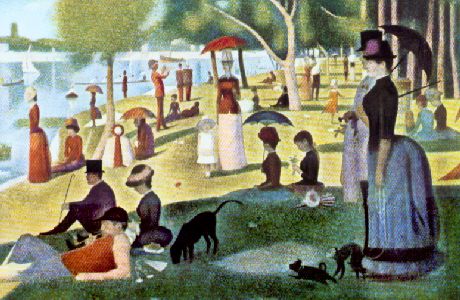
   
Painting of hard bustle dresses - costume history.This later bustle fashion was very moulded to the body and the heavy corsetry gave an armour like rigidity to the silhouette. The pointed bodice began to look quite tailored.
Tailored garments had been introduced in 1874 and their influence on design was subtle, but led eventually to the tailor made suit so fashionable in the 1890s.
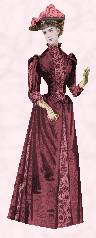

Picture of dress after bustle declined. Fashion history
In 1887 the sleeves were still slimmer, plain and close fitting. The sleeves look like quite a different style than on the bustle dress of the 1870s which had sleeves that would not have looked out of place on dresses of 1860.
By 1889 silhouette changes now couturier led were changing more rapidly and the sleeve developed a very slight leg of mutton outline which soon needed support.

Right - Dress of 1889 showing signs of elevation at the sleeve head. 


Victorian Fashion History - Power Dressing
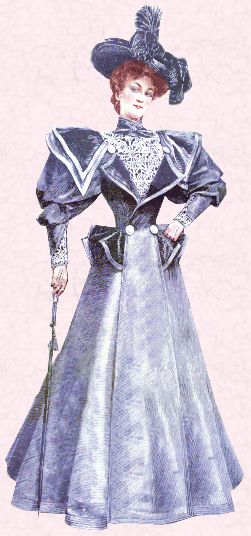


Picture of tailored full sleeved suit. Fashion historyIt's interesting to note how late Victorian women embraced the sharper tailored jacket fashion which gave them a different posture with a more confident air reflecting the ideals of early female emancipation. Other military and more tailor made styles of jacket were also popular. Some dresses also had a more severe air about them.

Left - Tailor made suit of 1895.


There are similarities in the period 1885 with 1985 when women also showed their strength in the corporate workplace with Power Dressing through more masculine tailored, shoulder padded clothes. A similar broad shoulder trend occurred in the Utility Clothing era of the 1940s when women did work usually thought of as men's work.


Bright Aniline Dyed Colours


The gowns of the 1880s were almost always made in two colours of material. Vivid colours such as deep red, peacock blue, bright apple green, royal blue, purple, mandarin, sea green were used alone, in combination, or in tartan fabrics. Some colour combinations were very strange.
At night ladies evening dresses were in softer hues and although they were extravagantly trimmed in contrast fabrics and very décolleté, they followed the general line of fashion.

1890s
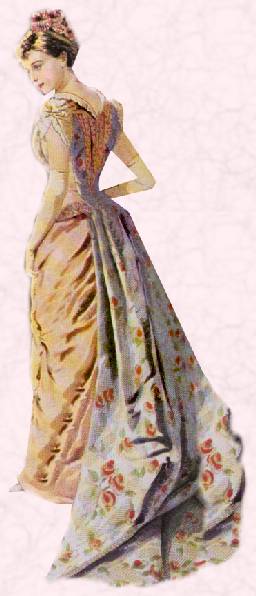
Gradually the skirt widened and flared as the fullness of the bustle began to fall into pleats down the garment back eventually disappearing to nothing.
As before the bustle foundation softened until only a small pad was left by 1893. The armour like hour glass figure soon developed into the S-Bend shape corset which set the Edwardian Corsetry silhouette until 1907-8. 

Left - Evening gown with train 1890. 


Leg of Mutton Sleeves


The leg of mutton sleeves continued to develop and sprouted high above the shoulders, By 1895 the sleeves swelled into enormous puffs similar to those of 1833. As happened in 1830 to balance the huge shoulders the skirt widened and flared, whilst keeping the waist tight and handspan narrow.
Queen Victoria's influence over fashion was long gone. people who were in mourning still followed court guidelines on mourning dress. The real royal influence in fashion was the wife of the Prince of Wales, Princess Alexandra. Together they set the tone for society and fashion in the last decade of the century in the 1890s and into their own reign of the Edwardian era from 1901 to 1910.


Pauline Weston Thomas . (Year Unknown). Mid-Late Victorian Fashion and Costume History. Available: http://www.fashion-era.com/mid-late_victorian_fashion.htm. Last accessed 12/10/2011.

Chris

Tuesday, 11 October 2011

Character design: Using Circles to construct character's

In this class the focus was using circle shapes to structure the key parts of a characters body. Here are the character's I used to do this task with.


Chris

Thursday, 29 September 2011

Generi guy lip sync

The first Maya class indulged in the (re)introduction of Generi guy, of which Alan went over the subject of lip syncing a character to an audio dialogue. The first part of this technique is known as the jaw bounce, which is practically opening and closing the jaw as if the character is a standard puppet.
Here is the basic looking face of generi guy before pulling his jaw joint about, notice how I have clicked on the line below the jaw which allows me to then use the pivoting action to regulate the movement of the jaw bounce.

Here is the set up for when animating the jaw bounce. As you can see, there is an attribute editor open at the side where the jaw's position is key framed each time it is moved into position along the timeline.


  • I finally got the jaw bounce complete and then further went to apply the phonemes to the characters animated jaw actions.


Wednesday, 28 September 2011

Character design: The Victorian era and Japan

The Steampunk genre is based within the time of the Industrial revolution around the time of the Victorian ages, however the world is warped into a mash up of futuristic concepts with the visual appeal of the old technology.

The myth of the exotic East has always been a potent one in the West, fuelling such images as Coleridge's 'stately pleasure domes'. By the time Victoria came to the throne in 1837, however, the romantic yearning to penetrate hidden worlds was being superseded by a desire to reach the apparently enormous, but hither to untouched, markets of East Asia. With the 'opening' of China and Japan fantasies met with realities and new mythologies and stereotypes of the East were constructed.

Unknown. (Unknown). The Victorian vision of China and Japan. Available: http://www.vam.ac.uk/content/articles/t/the-victorian-vision-of-china-and-japan/. Last accessed 29/09/2011

This goes to show how Victorian Britain found mystery within the oriental world, associating it with mythical beasts and worlds alien to themselves.

In 1868, there was a revolution in Japan, which resulted in the overthrow of the shogun, the military ruler, and the restoration of the power of the Meiji emperor. The new Meiji government initiated a major transformation of Japan along western lines, in order to achieve parity with the West rather than be dominated by it. Japan participated in all subsequent international exhibitions, these events gave them the opportunity to garner international prestige, to acquire the latest technological information about the West and to promote the country's own products.

Unknown. (Unknown). The Victorian vision of China and Japan. Available: http://www.vam.ac.uk/content/articles/t/the-victorian-vision-of-china-and-japan/. Last accessed 29/09/2011.

This shows how the revolution in 1868 gave way to allowing the Victorians to indulge themselves into the Japanese culture, which gained popularity due to its difference with known culture.

During the reign of Queen Victoria Britain emerged as the most powerful trading nation in the world, provoking a social and economic revolution whose effects are still being felt today.

Paul Atterbury. (2011). Victorian Technology. Available: http://www.bbc.co.uk/history/british/victorians/victorian_technology_01.shtml. Last accessed 28/09/2011.

Now imagine this, the enthusiastic designs based on mythical, oriental origins collided with the rich and powerful world of the Victorian age. New things would be being constantly built, extravagant designs wouldnt be held back due to a sense of revolution and instead of just standard buildings you would find elegance through a more simplistic, less blocky design. Merge this with the futuristic elements of Science Fiction and you would get an ambiguous landscape from another world.

Chris

Character design - Steampunk/Ninja enviromental ideas

The enviromental designs are key to how the Character should physically appear, also being a basis of what drives their personality or on screen counterparts. Therefore I think it is important that I visually analyse some different key locations that my project fits within.

Interestingly enough my concept of a City above the old world isnt without it's ties to reality. In modern China, there is such an increase in population that they have no choice but to consider new options, one being building on top of their current landscape.

(Full article found here)

http://whatmatters.mckinseydigital.com/cities/china-s-cities-in-the-sky

A few key points to note are:

  • Over a billion people will live in China’s cities by 2030, requiring construction on a scale never before seen. This gives China a unique opportunity to create and develop its cities in a way that supports economic growth, preserves the environment, delivers the highest possible quality of life for its citizens, and results in a stream of valuable new technologies. If handled correctly, these developments will not just benefit China but will also have profound implications for the rest of the 21st century world.

  • Each of these megacity clusters would have an economic scale equivalent to a moderately sized European country. Greater Shanghai could be as big as Germany today, while the central Yangzi cluster around Wuhan might be France.

  • Just as New York, with its scale and talent, made Wall Street possible, China’s megacities will create unprecedented opportunities to develop service industries by enhancing the scale and frequency of interactions. Cities in China will become models for the rest of the world, achieving a large scale of industry and financial-market depth. Spending on culture, recreation, health care, and education will grow by orders of magnitude from their current languishing state.

  • China’s demand for energy will double over the next two decades even as energy efficiency also doubles. Both existing and new sources of energy will be required. China will become a major coal importer even as it turns away from fossil fuels to become the world’s largest nuclear and renewable energy producer.

  • The choices that its city leaders make will shape not only its buildings but also its society, and indeed the world.

  • China’s cities will encourage a high level of environmental investment, with waste and water recycling becoming a way of life for both industry and consumers. Water will become a more valuable commodity and encourage investment in water efficiency as well as the world’s largest water treatment projects. Large, integrated recycling projects will minimize the impact of industrial and energy production.

Jonathan Woetzel. (2011). China’s cities in the sky. Available: http://whatmatters.mckinseydigital.com/cities/china-s-cities-in-the-sky. Last accessed 28/09/2011.

Sounds familiar doesnt it? This gives me confidence in my story idea that I can persue the course that I am taking. Here are a few images placed together within an influence map to help me further grasp an understanding into the mash up's needed to create my Characters enviroment.


All of these different landscapes seem to amazingly merge into one despite their vast differences. There is apocalyptic scenes from mankind's own self made destruction, there is science fiction based futuristic Cities floating in the sky, there are Steampunk Cities (already similar to my envisionment) and there are basic estimations of a typical futuristic City scape.

Chris

Character design - Synopsis update and Ninja research

I have decided to follow the route of a genre mash up where the Ninja is more of a symbolic creation based upon the dogma of its origin. The Ninja would be a constructed, well trained, steampunk robot that follows the ancient art of Shinobi as his form of power. The Ninja would be made to originally gain control over the population of the Steampunk City, however there is one that the inventor creates especially to rebel against the system to save the lives of thousands of innocent people.

Ninja research!

Ninjitsu is supposed to have originated more than 2,000 years ago as a treatise on the art of spying in the ancient Chinese book on military science called Sun Tzu. It was written by the great Chinese strategist Sun Wu who lived between 500 and 300 B.C.

Andrew Adams (1970). Ninja: The Invisible Assassins. California: Ohara. p31-190

Legends even in their own time for their amazing cloak-and-dagger deeds, the ninja were actually capable of performing feats far more fantastic than the mythological marvels accorded them by modern-day films and books. Indeed, the real-life exploits of these sinister bands of espionage experts rival anything ever dreamed up for the fictional super-agent known as James Bond.

Supernatural tales claim the ninja was able to fly, walk on water, live underwater like a fish, become invisible at will, sink into the ground, flow through stone walls, disappear in a puff of smoke and even transform himself into a snake, frog, bird of insect, Improbable as these stories may seem, there is a logical explanation for each one, a spark of truth behind the billowing screen of smoke.

Andrew Adams (1970). Ninja: The Invisible Assassins. California: Ohara. p23/24-190.

These apparent claims that stereotype the Ninja give a feel that the identity of its original source has been lost over time, becoming more of a fictional character based on a real existence. When designing a Character of this nature, this distortion of the true facts would have to be put into play to create anything of recognition to the image of a Ninja.

This is the often conceived image of a typical Ninja:


Unknown. (2011). Ninja material. Available: http://entertheninja.net/?paged=2. Last accessed 28/09/2011.

Technically my Ninja could undergo training similar to that which a real Ninja would follow.

The first step in Ninpo training is that of physical endurance. The important thing here is to polish your techniques, use your spirit, and endure physical forces until you reach a critical state where everything is on the line. The second step is that of mental and emotional endurance. If an animal encounters an enemy, in generally bares its teeth straight away and launches into a fight. However, no matter how fearsome the enemy, human beings have the ability to laugh. Even if somebody comes to cut at you with a sword, as long as your heart does not waver you can smile at them, endure the situation physically and flee without injuring them. My teacher used to say "Harmony has supreme importance in a warrior's heart." This concept of "harmony" really refers to the fact that everything in the universe is connected, everything in nature, all the seasons, love and hate, good and evil - all are interconnected aspects of a fundamental unity. The third step is the endurance of knowledge. The word "Knowledge" (Shiki) can also be interpreted phonetically as "four fears". The image here is that someone at the top of a pyramid (in the metaphorical sense too) can see clearly in all four directions, gaining in the same way a comprehensive, balanced understanding of nature's cycles (i.e the four seasons), and that this perspective frees you from fear. While mental and emotional endurance can be an active process of setting your mind to endure, enduring knowledge goes beyond both physical and emotional endurance to a level where you develop the power to understand everything without conscious thought. This means not just responding to things that have already happened, but sensing things that are about to happen and handling them naturally. In other words, enduring knowledge is connected with having a rich education, while also practising endurance with respect to ones own sixth sense and subconscious mind.

Masaaki Hatsumi, Ben Jones (2004). The Way of the Ninja: Secret Techniques. Unknown: Kodansha International. p22/24 of131.

This gives me the insight to possibly make this long process a part of which helps to keep the television series ongoing, where the Ninja Steampunk Robot is learning the ways from his Master and we follow him on his adventure into completing his training and undergoing missions on the way.

Character design - Shapes

In this lesson we was lectured on how the importance of shapes defines a Characters persona. We was individually given separate famous Characters from well known fictional creations and told to reconstruct the approach of the character by using a different approach of shapes.

I was given Superman, the bold, caring, bright coloured flying hero we all know and love. I decided to kill that notion, using triangular formations to help turn him "evil" (red Kryptonite anybody?). I tried to keep certain characteristics familiar, such as the boldness that usually depicts his heroic nature, however combined with the triangular sinisterism helps to contrive brutality instead.

  • The first thing I done was to draw Superman's image with basic shapes:


  • I then continued to design the character in his new form as an instinctive drawing which I could later analyse and resdesign based on visual flaws.


  • I then went on to persue the flaw of this character, which was his facial regonition. It didnt read as Superman, moreso as a the joker from Batman, which takes away from the actual point of the characters evil conversion. After playing around with his face a few times, I redrew the character closer to that of Supermans actual physical traits.


  • I was then asked to recreate my image in a different stylistic manner. The approach I took was the "as close to real as Disney would get" approach, so still Cartoony in depiction however with more subtle details and more realistic anatomical representations.


Chris

Wednesday, 21 September 2011

Character Design: Steampunk Ninja Synopsis ideas

Steampunk Ninjas

Story ideas for synopsis.

Target Audience: Older Teenagers, Male's, Sci Fi fans.

Steampunk world:

This is a time when the world is beginning to collapse on its own systems, technologies and independence. The world as we know it is changing. Time is seemingly having to go back to go forwards for those who have learnt how to adapt. There is a large City which is built up on itself, underneath remains of an old nuclear dependant society that practically destroyed itself. Here is where the new age lives, the Steampunk revolution has finally arrived.

Houses are built in a strange way of which can contain large steam based generators for energy. Car's are obviously closer to that of the traction engine, however shall be more in visual reference to the modern day sports car. There will be a tram which floats through the sky via a large hot air
balloon type system, which most regular people have to take to get to their work each day. The social hierarchy is similar to that of the Victorian ideals therefore it is a time where people are strict, look up to those above them and it would be common for someone to literally work as an upper class
persons slave. These people would work in the depths of the rich peoples houses, fueling their homes so they can survive. In this world it is always warmer than in real reality, as the platform streets they walk amongst are heated from below where the workers are sweating away. They never dare to venture outside of their City due to the perceived state of the world outside.

Fear is an important role in the upholding of this City, therefore punishment doesn't go unspoken for. If someone does something wrong they are burned alive to help fuel the fires that rage underneath. It is important that these issues go almost unspoken about however, as the wealthy and important people of the City are kept in comfort from any social concerns. Of course, most of these people are happy to be dismissive about such issues just as much as we are towards world wide problems of today.

From here the story could develop so that the Hero Steampunk is either:

  • A worker who wants to fight to set his people free. Perhaps there is a leader to this revolution who is the one to stop to regain equality.
  • An immigrant of important status, Sky trammed over to observe work on the City and witnesses an incident involving a worker. This person he helps could possibly become his sidekick, who together go on a mission to end the blindness of the City's Hierarchy.
  • A new form of soldier especially created by the Steampunk scientists to keep order to the City, however one was made differently (on purpose?). Therefore the Scientist, or someone who works for the development of the robots could become the sidekick)
Some of these ideas can be comparable to films such as Minority Report, Equilibrium, The Matrix etc As they are all about society as we know it drastically changing in development for a new world order.

Any ideas to go towards this to help me develop my Synopsis would be most welcome!

Chris

Character design - Steampunk research

The title for the Animation I am designing Characters for is "The Steampunk Ninjas". This being said, I don't know a great deal about the world of Steampunk even though ive seen a bunch of films in that genre. I think its best to further investigate this term to get a better understanding of what it entails.

Steampunk fashion:

"In three short words, steampunk is Victorian science fiction. Here “Victorian” is not meant to indicate a specific culture, but rather references a time period and an aesthetic: the industrialized 19th century."

GD Falksen . (2009). Steampunk 101. Available: http://www.tor.com/blogs/2009/10/steampunk-101. Last accessed 21/09/2011.

This brief description hits the nail on the head, it directly targets how the Steampunk fashion is relevant to a certain way of life associated with the past however merged with the technological extremes of today or the future. The Steampunk world creates a modern romantic movement in some senses, where the ideals of the past have moved forwards in a different way to modern reality.


Steampunk fashion: One of the only trends known to man where its alright to casually carry a mahoosive scary machine gun down the road.


PBS Arts. (2011). PBS takes on Steampunk. Available: http://www.steampunk.com/. Last accessed 21/09/2011.

Youtube link: http://www.youtube.com/watch?feature=player_embedded&v=z6-AmXihFsU

My favourite part of this video is at the end where it gives clear, humorous examples of 7 things that would be better "Steampunk'd". I actually think in a post technological revolutionary era where where we was still relying on the power of steam to be visually quite interesting, therefore although it was a dirty time full of smog, bad health and hard labour there is an innocence that is captured within the overall simplicity.


Unknown. (2011). Mens Steampunk Fasion.
Available: http://www.robotvsbadger.com/images/mens-steampunk-fashion-20-images/. Last accessed 21/09/2011.

As you can see, the Steampunks don't hold back. It is almost as if there is a longing for the world to have evolved in a different way, or an awareness that perhaps more natural resources of power could be better than that of, for example, nuclear fusion.

This subculture gives a whole range of open possibilities to what to expect. How would a telivision work? Would they exsist? How would we fly to other countries, what would the contraptions used look like? Would the weapons produce blasts of energy in a typical futuristic sense or would they be harmful steam throwers, projecting directed streams of overheated gasses? This gives me a whole range of concepts to play with and a platform of which originality is key.


I have created a small influence map in response to the visual peices of Steampunk work that I find most attractive.

Chris

Character Design - Steampunk Ninja's!

In the first lesson Justin went over simple facts about the defining attributes to the anatomy of certain characters, be they evil or good. After watching a long montage of animated characters we analysed different well known hero's and villains to see what makes them so visually appealing.

Notice with heroic character's the rounder features, the brighter colours and the bold chest (unless a sidekick). Also observe how the eyes are rounded and affectionate in nature and that there is always a sense of innocence about them. The Villains however are full of harsh spiked, triangular formations which either hunch over (typically the sidekicks) or are slim and snakelike in build. Their eyes tend to be dark as if wearing eyeliner, or somewhat animorphic in nature. Sometimes Villains can be found to have a large, bold chests similar to the heros, but usually more elaborated and in a way to make them less humanlike and therefore less approachable due to familiarity. Sidekicks are usually small in nature, less prominent and most often extremely silly, however take on some of the attributes of which their partner's characteristics embrace.
 
Hero's:

Teenage Mutant Hero Turtles


Villains:

Jafar (from Aladdin)


Sidekick's:

Good sidekick! Musha (from Mulan)


Evil sidekick's! Pain and Panic (Hercules)


For my Character project I have been given the subject of "Steampunk Ninja's", which obviously should be a more than fun challenge! First job is to create a synopsis explaining a breif backstory about the characters in hand as if they are to be part of an on going Cartoon TV series.

Here is the character mash up I got to try in class today.

The futuristic nerd


Chris